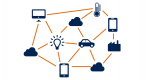
IoT Programming with C Training Course
The Internet of Things (IoT) refers to a network infrastructure that wirelessly links physical devices and software applications, enabling them to communicate and exchange data through network protocols, cloud computing, and data acquisition. C is a versatile, general-purpose programming language widely recommended for IoT development due to its widespread adoption and advantages in low-level programming.
During this instructor-led live training, participants will learn how to develop IoT solutions using C.
Upon completion of this training, participants will be able to:
- Install and configure NetBeans for C-based IoT development
- Grasp the foundational concepts of IoT architecture
- Recognize the advantages of using C for IoT system programming
- Build, test, deploy, and troubleshoot an IoT system using C
Audience
- Developers
- Engineers
Course Format
- A mix of lectures, discussions, exercises, and extensive hands-on practice
Note
- To request customized training for this course, please contact us to arrange.
Course Outline
Introduction to the Internet of Things (IoT)
- Understanding IoT Fundamentals
- Examples of IoT Devices and Platforms
Overview of IoT Solutions Architecture
- IoT Components
- Analog Sensors and Actuators
- Digital Sensors
- Internet Gateways and Data Acquisition Systems
- Data Aggregation
- Analog to Digital Conversion
- Edge IT
- Analytics
- Pre-Processing
- Data Center / Cloud
- Analytics
- Management
- Archive
Why C is an Ideal Language for Building IoT Programs
Overview of NetBeans for C Programming
Installing and Configuring NetBeans
Building an IoT System with C
- Connecting and Managing Devices
- Extracting and Analyzing Data from Devices
- Storing, Managing, and Acting on Data
Testing and Deploying an IoT System with C
Troubleshooting
Summary and Conclusion
Requirements
- Basic experience with C programming
- Basic familiarity or experience with microcontrollers
Open Training Courses require 5+ participants.
IoT Programming with C Training Course - Booking
IoT Programming with C Training Course - Enquiry
IoT Programming with C - Consultancy Enquiry
Testimonials (5)
The ability of the trainer to align the course with the requirements of the organization other than just providing the course for the sake of delivering it.
Masilonyane - Revenue Services Lesotho
Course - Big Data Business Intelligence for Govt. Agencies
The oral skills and human side of the trainer (Augustin).
Jeremy Chicon - TE Connectivity
Course - NB-IoT for Developers
The training was relevant to my needs and I would be able to apply the lessons learnt to meet my challenging needs
Botshabelo Jason - Water Utilities Botswana
Course - IoT Fundamentals and Frontiers : For Managers, CXO, VP, Investors and Entrepreneurs
Practical examples and wider context given.
James - Mitsubishi Electric R&D Centre Europe BV (MERCE-UK)
Course - IoT Programming with Python
I enjoyed the relaxed mood. Also there was a very good balance between theoretical presentation and practical side.
Calin Berariu - Continental Automotive Romania SRL
Course - Programming for IoT with Azure
Upcoming Courses
Related Courses
5G and IoT
14 HoursThe objective of this training is to clarify the nature of 5G networks and their impact on smart technologies. We aim to demonstrate both the advantages and disadvantages of the relationship between these technologies (5G and IoT), while highlighting the developmental trajectory of a network designed from the outset for the smart world.
6G and IoT
14 Hours6G, the forthcoming generation of wireless communication standards, is poised to revolutionize IoT ecosystems by delivering ultra-high-speed connectivity, sophisticated sensing capabilities, and seamlessly integrated AI functionalities.
This instructor-led live training, available online or onsite, is designed for advanced participants aiming to comprehend and harness the emerging synergy between 6G technologies and IoT applications.
Upon completing this course, learners will be equipped to:
- Articulate the fundamental technical principles underpinning 6G.
- Analyze how 6G will redefine IoT device communication and architectural frameworks.
- Evaluate 6G-enabled IoT use cases across various industries.
- Develop strategies for integrating 6G capabilities into current IoT solutions.
Course Format
- Concept-centric lectures paired with expert-led discussions.
- Practical exercises designed to reinforce core engineering principles.
- Guided case-based exploration and scenario analysis.
Course Customization Options
- For customized training versions aligned with your organization's technology roadmap, please contact us to arrange.
Big Data Business Intelligence for Govt. Agencies
35 HoursTechnological advancements and the exponential growth of information are reshaping business operations across numerous sectors, including the public sector. Government agencies are generating and archiving digital records at an accelerating pace, driven by the proliferation of mobile devices and applications, smart sensors, cloud computing solutions, and citizen-facing portals. As digital information becomes more voluminous and complex, the challenges associated with information management, processing, storage, security, and retention intensify. Emerging tools for capture, search, discovery, and analysis are enabling organizations to extract valuable insights from unstructured data. The government sector has reached a critical juncture where leaders recognize information as a strategic asset. To better serve citizens and meet mission requirements, governments must protect, leverage, and analyze both structured and unstructured information. As government leaders work to evolve into data-driven organizations, they are laying the groundwork to correlate dependencies across events, people, processes, and information.
High-value government solutions are being created through the integration of disruptive technologies:
- Mobile devices and applications
- Cloud services
- Social business technologies and networking
- Big Data and analytics
Big Data serves as an intelligent industry solution, enabling governments to make better decisions by acting on patterns revealed through the analysis of large volumes of data—both related and unrelated, structured and unstructured.
However, achieving these goals requires more than just accumulating massive amounts of data. "Making sense of these volumes of Big Data requires cutting-edge tools and technologies that can analyze and extract useful knowledge from vast and diverse streams of information," wrote Tom Kalil and Fen Zhao of the White House Office of Science and Technology Policy in a post on the OSTP Blog.
The White House advanced this effort by establishing the National Big Data Research and Development Initiative in 2012. This initiative allocated over $200 million to maximize the potential of Big Data and the tools required to analyze it.
The challenges posed by Big Data are nearly as formidable as its promise is encouraging. Efficiently storing data is one significant challenge. With budgets remaining tight, agencies must minimize the cost per megabyte of storage while ensuring data remains easily accessible so users can retrieve it efficiently. The need to back up massive amounts of data further exacerbates this challenge.
Effectively analyzing data presents another major hurdle. Many agencies utilize commercial tools to sift through large datasets, identifying trends that improve operational efficiency. (A recent MeriTalk study found that federal IT executives believe Big Data could help agencies save over $500 billion while also fulfilling mission objectives.)
Custom-developed Big Data tools are also helping agencies meet their data analysis needs. For instance, the Oak Ridge National Laboratory’s Computational Data Analytics Group has made its Piranha data analytics system available to other agencies. This system has helped medical researchers identify links that can alert doctors to aortic aneurysms before they occur. It is also used for routine tasks, such as sifting through resumes to match job candidates with hiring managers.
Digital Transformation with IoT and Edge Computing
14 HoursThis instructor-led, live training in Taiwan (online or onsite) is designed for intermediate-level IT professionals and business managers who aim to understand the potential of IoT and edge computing for driving efficiency, real-time processing, and innovation across various industries.
By the conclusion of this training, participants will be able to:
- Grasp the foundational concepts of IoT and edge computing and their significance in digital transformation.
- Identify practical use cases for IoT and edge computing in manufacturing, logistics, and energy.
- Differentiate between edge and cloud computing architectures and their deployment contexts.
- Implement edge computing solutions for predictive maintenance and real-time decision-making.
Edge AI for IoT Applications
14 HoursThis instructor-led, live training in Taiwan (online or onsite) is aimed at intermediate-level developers, system architects, and industry professionals who wish to leverage Edge AI for enhancing IoT applications with intelligent data processing and analytics capabilities.
By the end of this training, participants will be able to:
- Grasp the fundamentals of Edge AI and its application in IoT.
- Establish and configure Edge AI environments for IoT devices.
- Create and deploy AI models on edge devices for IoT applications.
- Implement real-time data processing and decision-making in IoT systems.
- Integrate Edge AI with various IoT protocols and platforms.
- Address ethical considerations and best practices in Edge AI for IoT.
Edge Computing
7 HoursThis instructor-led, live training in Taiwan (online or onsite) targets product managers and developers who wish to decentralize data management for faster performance, leveraging smart devices located on the source network.
By the end of this training, participants will be able to:
- Understand the basic concepts and advantages of Edge Computing.
- Identify the use cases and examples where Edge Computing can be applied.
- Design and build Edge Computing solutions for faster data processing and reduced operational costs.
Embedded Systems and IoT Fundamentals
21 HoursEmbedded systems are specialized computing platforms engineered to execute dedicated tasks within broader operational frameworks. IoT (Internet of Things) refers to a network of physical devices equipped with sensors and software, enabling them to connect and exchange data via the internet.
This instructor-led live training (available online or onsite) targets beginner-level technical professionals aiming to grasp and apply embedded systems and IoT principles using C and microcontroller architectures.
Upon completion of this training, participants will be able to:
- Comprehend the architecture and components of embedded systems.
- Write and compile C code for interacting with embedded hardware.
- Operate microcontroller peripherals such as timers and ADCs.
- Understand the role of embedded systems within IoT architectures.
Course Format
- Interactive lectures and discussions.
- Extensive exercises and practice sessions.
- Hands-on implementation in a live-lab environment.
Customization Options
- To request a customized training for this course, please contact us to arrange.
Federated Learning in IoT and Edge Computing
14 HoursThis instructor-led, live training in Taiwan (online or onsite) targets intermediate-level professionals who wish to apply Federated Learning to optimize IoT and edge computing solutions.
Upon completing this training, participants will be able to:
- Grasp the core principles and advantages of applying Federated Learning in IoT and edge contexts.
- Deploy Federated Learning models on IoT devices to enable decentralized AI processing.
- Minimize latency and enhance real-time decision-making within edge computing environments.
- Tackle challenges concerning data privacy and network limitations in IoT systems.
Programming for IoT with Azure
14 HoursThe Internet of Things (IoT) constitutes a network infrastructure that wirelessly links physical objects with software applications, enabling them to communicate and exchange data through network communications, cloud computing, and data capture. Azure provides a comprehensive suite of cloud services, including an IoT Suite comprised of preconfigured solutions designed to help developers accelerate the creation of IoT projects.
In this instructor-led live training, participants will learn how to develop IoT applications using Azure.
By the end of this training, participants will be able to:
- Understand the fundamentals of IoT architecture
- Install and configure Azure IoT Suite
- Learn the benefits of using Azure in programming IoT systems
- Implement various Azure IoT services (IoT Hub, Functions, Stream Analytics, Power BI, Cosmos DB, DocumentDB, IoT Device Management)
- Build, test, deploy, and troubleshoot an IoT system using Azure
Audience
- Developers
- Engineers
Format of the course
- Part lecture, part discussion, exercises and heavy hands-on practice
Note
- To request a customized training for this course, please contact us to arrange.
IoT Fundamentals and Frontiers : For Managers, CXO, VP, Investors and Entrepreneurs
21 HoursUnlike other technologies, the Internet of Things (IoT) is significantly more complex, encompassing nearly every branch of core engineering: Mechanical, Electronics, Firmware, Middleware, Cloud, Analytics, and Mobile. Each engineering layer involves distinct aspects of economics, standards, regulations, and the evolving state of the art. For the first time, this modest course offers a comprehensive coverage of all these critical IoT engineering aspects.
Summary
An advanced training program covering the current state of the art in the Internet of Things.
Crosses multiple technology domains to develop awareness of an IoT system, its components, and how it can benefit businesses and organizations.
Includes live demonstrations of model IoT applications to showcase practical IoT deployments across different industry domains, such as Industrial IoT, Smart Cities, Retail, Travel & Transportation, and use cases around connected devices & things.
Target Audience
Managers responsible for business and operational processes within their respective organizations who want to know how to harness IoT to make their systems and processes more efficient.
Entrepreneurs and Investors who are looking to build new ventures and want to develop a better understanding of the IoT technology landscape to see how they can leverage it in an effective manner.
Estimates for the Internet of Things (IoT) market value are massive, since by definition the IoT is an integrated and diffused layer of devices, sensors, and computing power that overlays entire consumer, business-to-business, and government industries. The IoT will account for an increasingly huge number of connections: 1.9 billion devices today, and 9 billion by 2018. That year, it will be roughly equal to the number of smartphones, smart TVs, tablets, wearable computers, and PCs combined.
In the consumer space, many products and services have already crossed over into the IoT, including kitchen and home appliances, parking, RFID, lighting and heating products, and a number of applications in Industrial Internet.
However, the underlying technologies of IoT are nothing new as M2M communication existed since the birth of the Internet. However, what changed in the last couple of years is the emergence of a number of inexpensive wireless technologies added by the overwhelming adaptation of smart phones and Tablets in every home. The explosive growth of mobile devices led to the present demand of IoT.
Due to unbounded opportunities in IoT business, a large number of small and medium-sized entrepreneurs jumped on a bandwagon of the IoT gold rush. Also, due to the emergence of open-source electronics and IoT platforms, the cost of developing IoT systems and further managing their sizable production is increasingly affordable. Existing electronic product owners are experiencing pressure to integrate their devices with the Internet or Mobile apps.
This training is intended for a technology and business review of an emerging industry so that IoT enthusiasts/entrepreneurs can grasp the basics of IoT technology and business.
Course Objective
The main objective of the course is to introduce emerging technological options, platforms, and case studies of IoT implementation in home & city automation (smart homes and cities), Industrial Internet, healthcare, Govt., Mobile Cellular, and other areas.
Basic introduction of all the elements of IoT-Mechanical, Electronics/sensor platform, Wireless and wireline protocols, Mobile to Electronics integration, Mobile to enterprise integration, Data-analytics, and Total control plane.
M2M Wireless protocols for IoT-WiFi, Zigbee/Zwave, Bluetooth, ANT+: When and where to use which one?
Mobile/Desktop/Web apps- for registration, data acquisition, and control – Available M2M data acquisition platforms for IoT–Xively, Omega, and NovoTech, etc.
Security issues and security solutions for IoT.
Open source/commercial electronics platforms for IoT-Raspberry Pi, Arduino, ArmMbedLPC, etc.
Open source/commercial enterprise cloud platforms for AWS-IoT apps, Azure-IOT, Watson-IoT cloud in addition to other minor IoT clouds.
Studies of the business and technology of some of the common IoT devices like Home automation, Smoke alarm, vehicles, military, home health, etc.
IoT Programming with Java
14 HoursThe Internet of Things (IoT) represents a network infrastructure that wirelessly links physical objects with software applications, enabling seamless communication, data exchange via network protocols, cloud computing, and data capture. As a versatile programming language known for its "write once, run anywhere" capability, Java is highly recommended for IoT projects due to its portability and efficiency.
In this instructor-led live training, participants will gain the skills necessary to develop IoT solutions using Java.
Upon completing this training, participants will be able to:
- Install and set up essential tools and frameworks, such as the Eclipse Open IoT Stack, to program IoT systems with Java
- Grasp the fundamental principles of IoT architecture
- Utilize the Eclipse Open IoT Stack for Java to connect and manage devices within an IoT solution
- Construct, test, and deploy IoT systems using Java
Audience
- Developers
- Engineers
Format of the course
- A blend of lectures, discussions, exercises, and extensive hands-on practice
Note
- To arrange customized training for this course, please contact us.
Industrial IoT (Internet of Things) for Manufacturing Professionals
21 HoursUnlike other technologies, IoT is far more complex encompassing almost every branch of core Engineering-Mechanical, Electronics, Firmware, Middleware, Cloud, Analytics and Mobile. For each of its engineering layers, there are aspects of economics, standards, regulations and evolving state of the art. This is for the firs time, a modest course is offered to cover all of these critical aspects of IoT Engineering.
For manufacturing professional, most critical aspect is to understand the advancement in the area of Industrial Internet of things, which includes predictive and preventative maintenance, condition based monitoring of the machines, production optimization, energy optimization, supply-chain optimization and uptime of manufacturing utilities etc.
Summary
- An advanced training program covering the current state of the art in Internet of Things in Smart Factories.
- Cuts across multiple technology domains to develop awareness of an IoT system and its components and how it can help manufacturing managerial professionals
- Live demo of model IIoT applications for smart factories
Target Audience
- Managers responsible for business and operational processes within their respective manufacturing organizations and want to know how to harness IoT to make their systems and processes more efficient.
Duration 3 Days ( 8 hours / day)
Estimates for Internet of Things or IoT market value are massive, since by definition the IoT is an integrated and diffused layer of devices, sensors, and computing power that overlays entire consumer, business-to-business, and government industries. The IoT will account for an increasingly huge number of connections: 1.9 billion devices today, and 9 billion by 2018. That year, it will be roughly equal to the number of smartphones, smart TVs, tablets, wearable computers, and PCs combined.
In the consumer space, many products and services have already crossed over into the IoT, including kitchen and home appliances, parking, RFID, lighting and heating products, and a number of applications in Industrial Internet.
However the underlying technologies of IoT are nothing new as M2M communication existed since the birth of Internet. However what changed in last couple of years is the emergence of number of inexpensive wireless technologies added by overwhelming adaptation of smart phones and Tablet in every home. Explosive growth of mobile devices led to present demand of IoT.
Industrial IoT, or IIoT for manufacturing has been widely in use since 2014 and since then a large number of IIoT innovations have taken place. This course will introduce all the important aspects of innovations in Industrial IoT area.
This training is intended for a technology and business review of an emerging industry so that IoT enthusiasts/entrepreneurs can grasp the basics of IoT technology and business.
Course Objective
Main objective of the course is to introduce emerging technological options, platforms and case studies of IoT implementation in smart factories for manufacturing sectors.
- Studies of business and technology of some of the common IIoT platform like Siemens MindSphere and Azure IoT.
- Open source /commercial enterprise cloud platform for AWS-IoT apps, Azure -IOT, Watson-IOT, Mindsphere IIoT cloud in addition to other minor IoT clouds
- Open source/commercial electronics platform for IoT-Raspberry Pi, Arduino , ArmMbedLPC etc
- Security issues and security solutions for IIoT
- Mobile/Desktop/Web app- for registration, data acquisition and control –
- M2M Wireless protocols for IoT- WiFi, LoPan, BLE, Ethernet, Ethercat, PLC : When and where to use which one?
- Basic introduction of all the elements of IoT-Mechanical, Electronics/sensor platform, Wireless and wireline protocols, Mobile to Electronics integration, Mobile to enterprise integration, Data-analytics and Total control plane
IoT for Power Utility: Fundamentals, Frontiers and Strategy
22 HoursConnected devices are disrupting numerous industries, and the power utility sector is no exception. Power utility companies currently face four primary challenges stemming from the growth of the Internet of Things (IoT):
- Vendors are increasingly connecting machines, controllers, HMIs, and SCADA systems to the cloud, promising enhanced analytics and insights for predictive and preventative maintenance. However, stringent quarantine policies governing critical assets prevent power companies from fully utilizing these new IoT features offered by machine and controller vendors.
- As the costs of solar and wind power microgrids continue to decline, utility companies will soon experience a drop in revenue from traditional power generation. To offset these losses, companies must aggressively pursue new revenue streams, such as home energy management as a service, energy storage as a service, and providing grid services for EV charging and peer-to-peer (P2P) energy trading between homes, microgrids, and batteries. All these transactions require smart metering, smart grids, and secure trading facilitated by Distributed Ledger Technology (DLT) like IOTA. Additionally, utilities are exploring opportunities to offer smart city services to municipal authorities.
- For critical infrastructure such as dams, the International Committee of Large Dams (ICOLD) mandates real-time Structural Health Monitoring (SHM). This allows for early warning of potential collapses in dams, rock formations, or tunnels, enabling the timely evacuation of affected populations.
- A new emerging revenue area is EV charging in parking facilities. This module explores how IoT can facilitate smart charging and smart parking solutions.
Over the past three years, IoT engineering has undergone massive changes, driven primarily by tech giants Microsoft, Google, and Amazon. These industry leaders have invested billions of dollars to develop IoT platforms that are easier to manage and secure. Furthermore, IoT edge computing has gained significant momentum in both research and deployment as the primary method for practical IoT implementation. The advent of 5G promises to transform the IoT business landscape, leading to unprecedented levels of research funding. Consequently, it is essential for practicing engineers to understand the IoT platforms developed by major players like AWS, Google, and especially Microsoft.
However, none of these platforms offer a fully exhaustive or comprehensive solution for scalable IoT. Deploying smart metering across millions of homes requires additional technologies to secure the meters, radio networks, IoT management systems, and numerous other secured services. The strategy, pricing, and security of any IoT deployment must be optimal and acceptable. Given the interdisciplinary knowledge required, it is nearly impossible for any single company to assemble a team capable of meeting all these requirements.
This course is a modest attempt to educate key decision-makers, developers, and security experts on the challenges, risks, and practical approaches to deploying IoT for their next-generation power utility business.
Additionally, with scalable deployment, managing IoT services for thousands of sensors and connections is emerging as a distinct engineering discipline. This area, formerly known as managed IoT services, is experiencing rapid growth because the challenges of scalable IoT management are far greater than just building the infrastructure. This includes securing over-the-top firmware/software updates, managing sensor and system calibration, auto-diagnosing connection issues, identifying root causes of API failures, and tracking the hardware and service health of distributed systems.
Course Objectives
The main objective of this course is to introduce emerging technological options, platforms, and case studies of IoT implementation in power utility companies, covering smart metering, smart cars, SHM (Structural Health Monitoring), power quality diagnosis, and smart contracts. It provides a basic introduction to all elements of IoT, including mechanical systems, electronics/sensor platforms, wireless and wireline protocols, mobile-to-electronics integration, mobile-to-enterprise integration, data analytics, and control plane applications.
- IoT Technology Stacks: Devices, gateways, edge, edge cloud, public cloud, IoT databases, web and mobile applications for IoT, and centralized vs. decentralized IoT.
- IoT ecosystem for business, third-party device management, and risk management of the entire IoT ecosystem.
- M2M wireless protocols for IoT: WiFi, SigFox, LoRa, LPWAN, Zigbee/Z-Wave, Bluetooth, ANT+: Understanding when and where to use each.
- Fundamentals of IoT gateways: Risks, management, and ecosystem.
- Mobile/Desktop/Web apps for registration, data acquisition, and control—Reviewing available M2M data acquisition platforms for IoT: AWS IoT, Azure IoT, and Google IoT.
- Security issues and solutions for IoT, including a review of security across all technology stacks.
- Enterprise IoT platforms such as Microsoft Azure IoT suites, AWS IoT, Google IoT, and Siemens MindSphere.
- Smart metering, Open Smart Grid Protocols (OSGP), ANSI C2.18 protocols, NIST standards for HAN (Home Area Network), HomePlug Powerline Alliance, and smart meter security standards (IEC 62056).
- Distributed Ledger Technology (DLT) such as blockchain, Hyperledger, and DAG (Directed Acyclic Graph) for smart contracts, P2P transactions, and smart car charging.
- IoT applications for critical infrastructure like dams, transformers, substations, and high-tension wires.
IoT Programming with Python
14 HoursThe Internet of Things (IoT) constitutes a network infrastructure that wirelessly connects physical objects with software applications, enabling them to communicate and exchange data through network communications, cloud computing, and data capture. Python, a high-level programming language, is recommended for IoT development due to its clear syntax and extensive community support.
In this instructor-led live training, participants will learn how to program IoT solutions using Python.
By the end of this training, participants will be able to:
- Understand the fundamentals of IoT architecture
- Learn the basics of using Raspberry Pi
- Install and configure Python on Raspberry Pi
- Learn the benefits of using Python in programming IoT systems
- Build, test, deploy, and troubleshoot an IoT system using Python and Raspberry Pi
Audience
- Developers
- Engineers
Format of the course
- Part lecture, part discussion, exercises and heavy hands-on practice
Note
- To request a customized training for this course, please contact us to arrange.
NB-IoT for Developers
7 HoursIn this instructor-led, live training in Taiwan, participants will learn about the various aspects of NB-IoT (also known as LTE Cat NB1) as they develop and deploy a sample NB-IoT based application.
By the end of this training, participants will be able to:
- Identify the different components of NB-IoT and how to fit together to form an ecosystem.
- Understand and explain the security features built into NB-IoT devices.
- Develop a simple application to track NB-IoT devices.